Pharaoh Ants vs Carpenter Ants: Identify and Eradicate in Montreal
Montreal, with its harsh winters and warm summers, provides a hospitable environment for various ant species seeking refuge in our homes and businesses. Among the most common and problematic invaders, pharaoh ants and carpenter ants stand out due to their distinct characteristics, behaviors, and the threats they pose. Although they are both ants, ignoring them or attempting a generic extermination solution can prove ineffective — or even make the situation worse. The key to successful pest management lies in accurate identification.
Understanding the fundamental differences between these two species is the crucial first step to eliminating them from your property. Misidentification can lead to inappropriate treatments, wasted time and money, and allow the infestation to spread. At ExtermExpress, experts in ant extermination in Montreal, we frequently encounter both types and have developed targeted strategies for each. This article will guide you through the distinguishing signs of each species, the potential damage they can cause, and the guaranteed professional eradication methods to protect your home or business in Montreal, Laval, Longueuil, and the Greater Montreal area.
Key Differences: Pharaoh Ants vs. Carpenter Ants in Montreal
Ant identification in Montreal is essential for choosing the right extermination approach. Pharaoh ants and carpenter ants are often confused, but their physical and behavioral characteristics are very distinct.Physical Appearance and Size
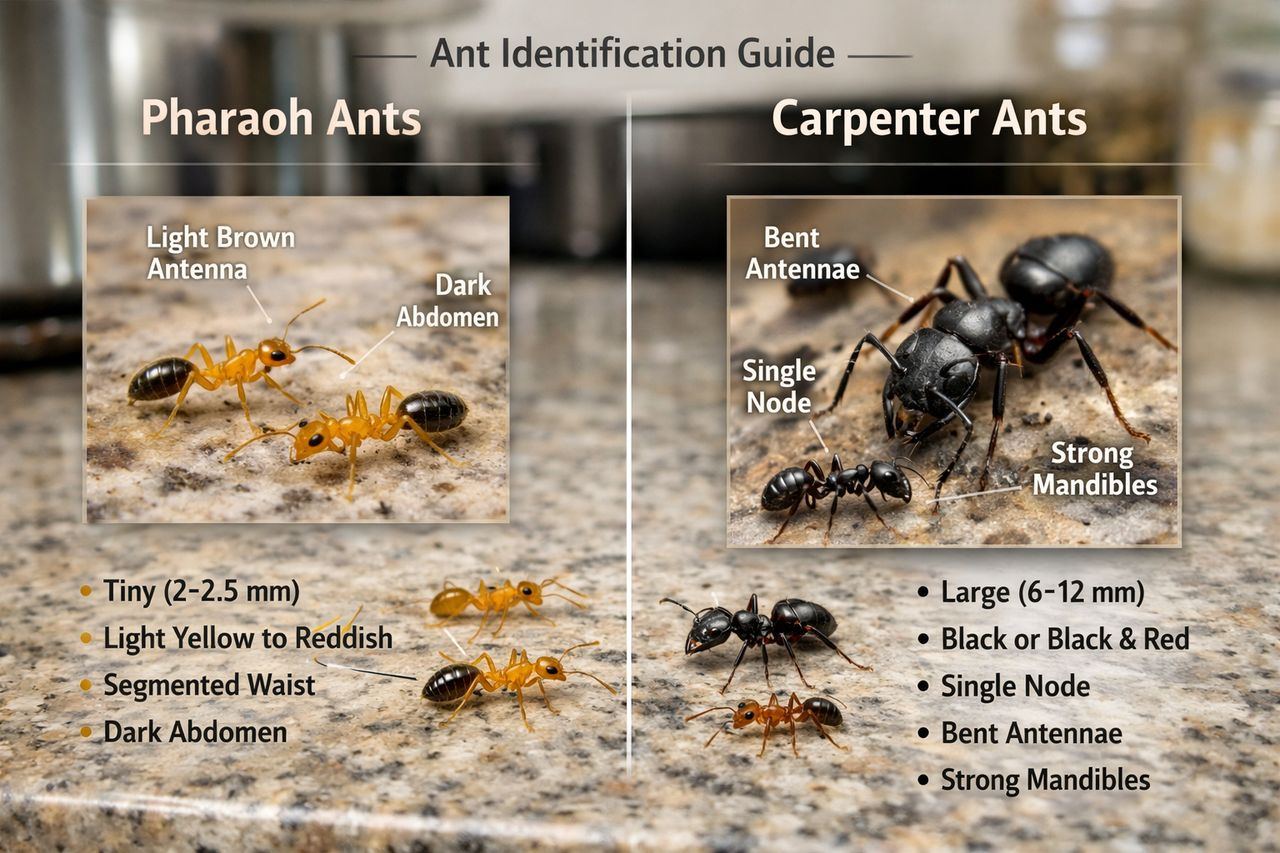
- Pharaoh Ants (Monomorium pharaonis): These tiny ants typically measure between 1.5 and 2 mm. They have a pale yellow to light brown color, with a slightly darker abdomen. Their body is segmented and they possess two nodes (petioles) between the thorax and abdomen, visible under magnification. They are often seen in long trails foraging for food.
- Carpenter Ants (Camponotus spp.): Much larger, these ants measure between 6 and 13 mm for workers, and up to 20 mm for queens. They are generally black, although some subspecies may have red or dark brown tones. Their thorax is uniformly arched (with no visible depression) and they have only one node (petiole) between the thorax and abdomen. Carpenter ants are among the largest ants found in the Montreal region, and even carpenter ants in Laval share the same characteristics.
Behavior and Nesting Habits
- Pharaoh Ants: These ants are known for their ability to establish multiple small "satellite" colonies dispersed throughout a structure, often connected by workers. They prefer warm, humid environments, making them common in hospitals, restaurants, and apartments. Their nests can be found in hard-to-reach places like behind walls, under floors, inside appliances, or in electrical wiring. Their "budding" behavior (colony fragmentation under stress) makes their eradication particularly challenging.
- Carpenter Ants: Contrary to their name, carpenter ants don't eat wood — they excavate galleries in damp or damaged wood to establish their nests. Their main nests are often outdoors (stumps, dead trees, rotting wood), but they establish satellite nests inside homes, preferring moisture-damaged wood around windows, under roofs, or in walls. They are primarily nocturnal and often leave wood shavings (called "frass") near nest openings. If you hear a rustling sound in your walls at night, it could be carpenter ants.
Diet and Preferences
- Pharaoh Ants: They have a highly varied diet but show a clear preference for sweet foods, fats, and proteins. They are particularly attracted to contaminated foods, wounds, sterile dressings in healthcare facilities, and even breast milk or wound exudates in humans.
- Carpenter Ants: They primarily feed on dead or living insects, tree sap, and honeydew produced by aphids. Inside buildings, they are attracted to sweet foods, meat, and human food scraps.
Damage and Risks to Your Montreal Property
Each of these ant species poses specific threats to human health and the structural integrity of your Montreal property. Never underestimate the impact of an untreated infestation.
Impact of Pharaoh Ants (Health and Contamination)
Pharaoh ants are considered major health pests, particularly in sensitive environments such as hospitals, nursing homes, and food processing plants. Their small bodies allow them to penetrate packaging, sterile equipment, and areas where cleanliness is paramount. They are vectors for pathogenic bacteria such as Salmonella, Staphylococcus, and Clostridium, which they can carry from contaminated areas to food or clean surfaces.
Their presence can lead to:
- Food contamination: They explore garbage, drains, and high-risk areas before contaminating food preparation surfaces or foodstuffs.
- Health risks: In healthcare facilities, they can contaminate sterile equipment, patient wounds, and even spread nosocomial infections. They are a serious threat to immunocompromised patients or newborns.
- Eradication difficulty: Their ability to "bud" means that improper insecticide application can disperse the colony and worsen the infestation, making the problem more widespread and harder to control.
Impact of Carpenter Ants (Structural Damage)
Carpenter ants don't eat wood, but they tunnel and excavate galleries to establish their nests. Over time, this activity can significantly weaken the wooden structures of your property, causing damage similar to that of termites.
Here are the main damages and risks:
- Structural damage: They prefer damp or rotting wood, but if the infestation is advanced, they can attack dry, healthy wood. Beams, joists, window and door frames, floors, and wooden walls can all be compromised. Damage can go unnoticed for years before becoming severe and costly to repair.
- Property value loss: An untreated carpenter ant infestation can seriously affect your property's value and make selling more difficult.
- High repair costs: Repairs for structural damage caused by carpenter ants can be very expensive, often not covered by home insurance if the infestation isn't reported and treated promptly.
Targeted Eradication Strategies for Each Species
The effectiveness of ant extermination depends on applying methods specifically adapted to the species. Attempting to use the same approach for pharaoh ants and carpenter ants can not only fail but also make the problem more complex to solve. This is where the expertise of a professional like ExtermExpress becomes indispensable for successful ant extermination in Montreal.
Effective Treatment Against Pharaoh Ants
Due to their budding behavior and multiple satellite nests, pharaoh ants cannot be effectively treated with spray insecticides. Direct-contact sprays will kill visible workers but stress the colony, pushing the queen to split and create new nests — transforming a localized problem into a widespread infestation.
The most effective method for pharaoh ants is the use of special baits:
- Identification and monitoring: A professional will locate ant trails and identify activity zones to strategically place baits.
- Slow-acting baits: Baits specifically formulated for pharaoh ants, containing a slow-acting active ingredient, are used. Worker ants carry this bait back to the nest to feed the queen and other colony members, including larvae.
- Queen elimination: The goal is to eliminate the queen(s), which causes the colony to collapse. This process can take several weeks, and continuous patience and monitoring are necessary.
- Safety assurance: ExtermExpress uses certified products that are safe for indoor environments while being effective against ants.
Eliminating Carpenter Ants
The approach for carpenter ants is different, as the goal is to locate and destroy the nest(s).
- Thorough inspection: Our technicians perform a detailed inspection to find the main nest (often outdoors) and satellite nests (indoors). They look for signs like "frass" (wood shavings), moisture, and entry points.
- Direct nest treatment: Once the nest is located, insecticides are applied directly into the galleries and cavities where the ants are found. This may involve drilling small holes in walls or wood to reach the heart of the colony.
- Entry point and perimeter treatment: Additionally, treatment is applied to exterior entry points and around the foundation to create a protective barrier and intercept ants attempting to enter or exit.
- Structural recommendations: We also provide advice on repairing moisture damage and weatherproofing your property to prevent future infestations.
Prevention and Follow-Up: Protect Your Home Long-Term
Once the infestation is eradicated, prevention is essential to avoid the return of ants. Professional follow-up and adequate preventive measures guarantee long-term peace of mind.
General Preventive Measures
To make your property less attractive to ants, whether pharaoh or carpenter, follow these tips:
- Eliminate food sources: Store food in airtight containers, quickly clean up crumbs and spills, and regularly empty trash cans.
- Manage moisture: Repair all water leaks (faucets, pipes, roofs) and ensure good ventilation in humid areas like bathrooms, basements, and crawl spaces. This is crucial for preventing carpenter ants.
- Seal entry points: Seal cracks in foundations, walls, around windows and doors. Use caulking or sealant to fill small openings.
- Exterior maintenance: Keep firewood away from the house, remove dead tree stumps, and trim tree branches that touch your roof or walls — these provide bridges for carpenter ants.
- Regular cleaning: Vacuum regularly and clean surfaces with household products.
The Importance of Professional Follow-Up
Even after a successful initial treatment, follow-up is often necessary, particularly for pharaoh ant infestations that may have hidden, persistent nests.
- Follow-up visits: ExtermExpress offers follow-up visits to ensure the infestation has been completely eradicated and that no new nests have appeared.
- Prevention programs: For commercial properties or high-risk areas, we can establish Integrated Pest Management (IPM) programs that include regular monitoring and preventive interventions.
- Personalized advice: Our experts will provide specific advice for your situation to keep your property ant-free long-term.
Frequently Asked Questions (FAQ)
1. What attracts pharaoh ants to my home?
Pharaoh ants are primarily attracted to easily accessible food sources (sugars, fats, proteins) and warm, humid environments. They are often found in kitchens, bathrooms, and near heat sources like appliances.2. How do I know if I have carpenter ants rather than other ants?
Distinctive signs of carpenter ants include their large size (6-13mm), predominantly black color, the presence of small piles of wood shavings (frass) near cracks in wood, and hearing rustling sounds in walls at night.3. Can I use a single type of treatment for both ant species?
No, it is strongly advised against using the same treatment. Pharaoh ants react poorly to insecticide sprays (which can trigger "budding" and disperse the colony), while carpenter ants require direct nest treatment that can be difficult to locate without expertise. Accurate identification and targeted treatment are crucial.4. Are ExtermExpress treatments safe for my children and pets?
Yes, at ExtermExpress, the safety of your family and pets is our priority. We use approved products applied strategically and in a targeted manner to minimize exposure. Our CD5-certified (MELCCFP) technicians follow strict protocols and will inform you of precautions to take before, during, and after treatment.5. How long does ant treatment take?
Duration varies by species and infestation extent. For pharaoh ants, complete eradication can take several weeks due to the nature of baits and the colony cycle. For carpenter ants, an initial intervention can quickly reduce activity, but follow-up is often recommended to ensure all nests are destroyed and prevent recurrence.Conclusion
Correct identification is the foundation of effective pest control. Pharaoh ants and carpenter ants may seem similar at first glance, but their differences in appearance, behavior, and potential damage demand radically different extermination approaches. From the food contamination and health risks posed by pharaoh ants to the costly structural damage inflicted by carpenter ants, neglecting an infestation can have serious consequences for your Montreal property.
Calling on qualified professionals like ExtermExpress ensures accurate identification and a custom eradication plan using safe and effective techniques and products. Our experts are trained to understand the specifics of each species and guarantee lasting results. Don't let ants take control of your home or business. Contact ExtermExpress today for a reliable solution and to regain your peace of mind.
Ready to say goodbye to ants? Get a free quote and protect your property. Contact ExtermExpress now.